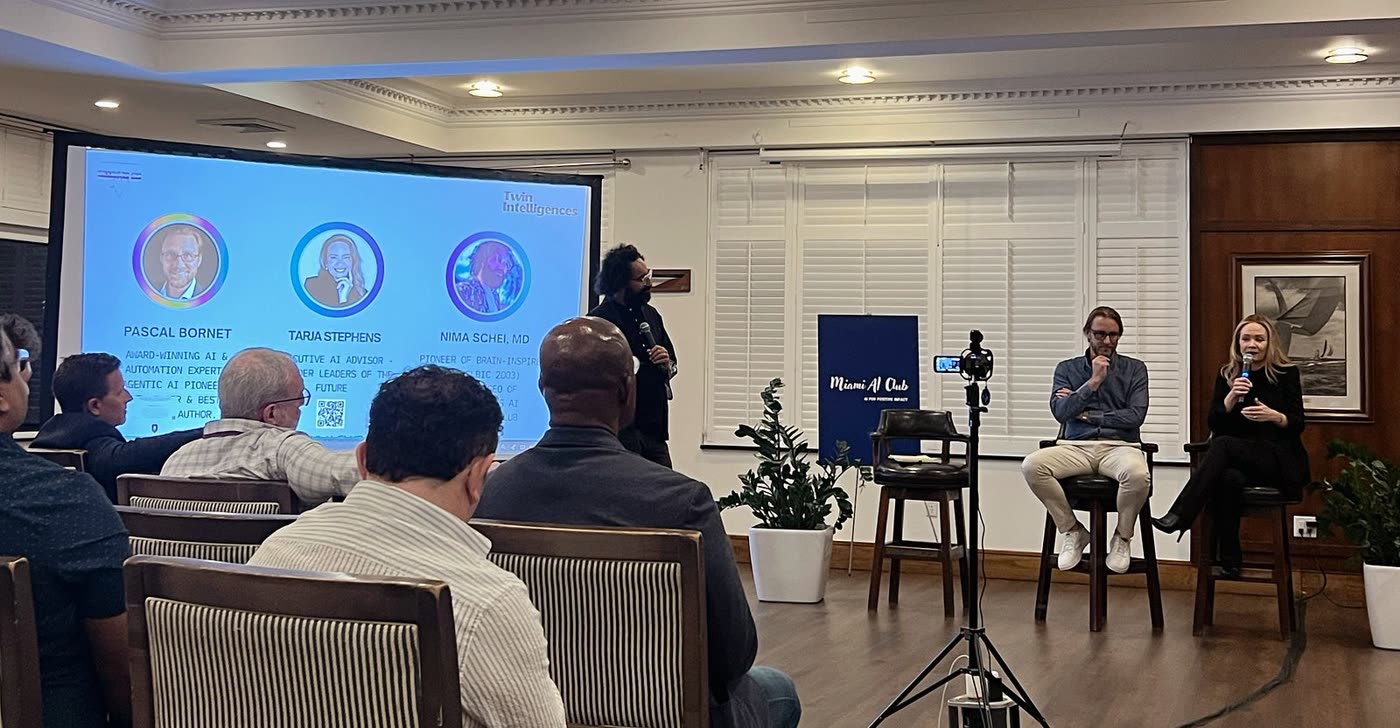
This month, Leaders of the Future Founder Tarja Stephens contributed to the Miami AI Club’s Twin Intelligences gathering, a forward-looking conversation exploring how Digital Twins and Agentic AI are reshaping leadership, workforce design, and the future of human capability. In dialogue with world-leading AI expert Pascal Bornet and moderated by Nima Schei, MD, the evening brought together global leaders and Miami’s fast-growing AI community to examine how human and digital intelligence are converging in this new era.
The discussion centered on a defining shift: as intelligent systems evolve from tools into autonomous actors, the foundation of work itself is being rewritten. Digital twins are emerging as real-time, evolving reflections of how individuals think, work, and grow. Agentic AI systems are beginning to collaborate in decisions, actions, and creative work. Together, they represent a profound transformation in how intelligence flows and how value is created across companies and economies.
Digital twins mark the beginning of an agent-to-agent economy, one where intelligent agents representing people or organizations can transact, negotiate, and make decisions on their behalf. It is a future in which a digital twin of a person could interact with the digital twin of a company, executing agreements with autonomy and precision.
The potential is enormous, yet the questions are equally significant:
How do we define this new layer of intelligence in the future of work?
What breakthroughs are needed for the adoption of digital counterparts?
And what safeguards must be in place to protect trust, dignity, and ownership?
Tarja contributed an essential human-centered perspective to this conversation, emphasizing the workforce transformation lens. She explored how digital twins can serve not only enterprise efficiency but also individual empowerment, grounded in ethical infrastructure that protects ownership, trust, portability, and transparency.
Her contributions examined several critical themes:
- The evolution from static résumés to intelligent professional profiles, redefining how talent is represented and recognized.
- How digital twins can shift from enterprise assets to tools of individual empowerment, enabling people to carry their skills, intelligence, and lived experience across roles and sectors.
- Where we draw the line between corporate IP and human intelligence, including tacit knowledge, personal agency, and emotional insight.
- The urgent question of employee digital twins, raising issues around governance, consent, co-ownership, and the rights of individuals in an AI-driven workplace.
These themes aligned with the broader session insights, where digital twins were defined as context-rich, evolving models of human or system intelligence, and agentic AI as autonomous actors capable of performing tasks on behalf of those models. Together, they establish a new architecture for participation in work and commerce, shifting organizations from systems that extract data to systems that amplify human capability.
Discussions also highlighted the three speeds of organizational readiness, Future Builders, Strategic Transformers, and Early Explorers, revealing how uneven the transition remains across companies and sectors. Each phase requires more than adoption: it demands redesigning organizations for augmentation, investing in executive learning, and reshaping culture for AI fluency and trust.
A powerful theme throughout the evening was the need for digital twins to become part of a more inclusive and human-centered future of work. Imagine a digital twin as a portable, living career companion that updates in real time, reflects how a person learns and leads, and empowers them with agency in the new economy. For organizations, this creates deeper visibility into talent, new pathways for inclusion, and the potential for more equitable access to opportunity.
Yet the risks are equally human-centered: Who owns the digital twin? Are people aware of how their behavioral data is being used? Could digital twins lock individuals into fixed representations? These questions call for ethical frameworks grounded in co-ownership, consent layers, data portability, and trusted governance.
The evening closed with an outlook toward the infrastructure that must be built. Digital twins hold the promise not just of optimization but of opportunity, if designed with intention. They could become the modern equivalent of global trade routes: systems that expand access, mobility, and participation across borders and sectors.
As Miami continues to emerge as a global ecosystem for human-centered AI, Leaders of the Future is honored to support conversations like these, where technological possibility meets leadership responsibility, and where the future of work is shaped not only by intelligent systems but by the principles we choose to encode into them.
About Miami AI Club
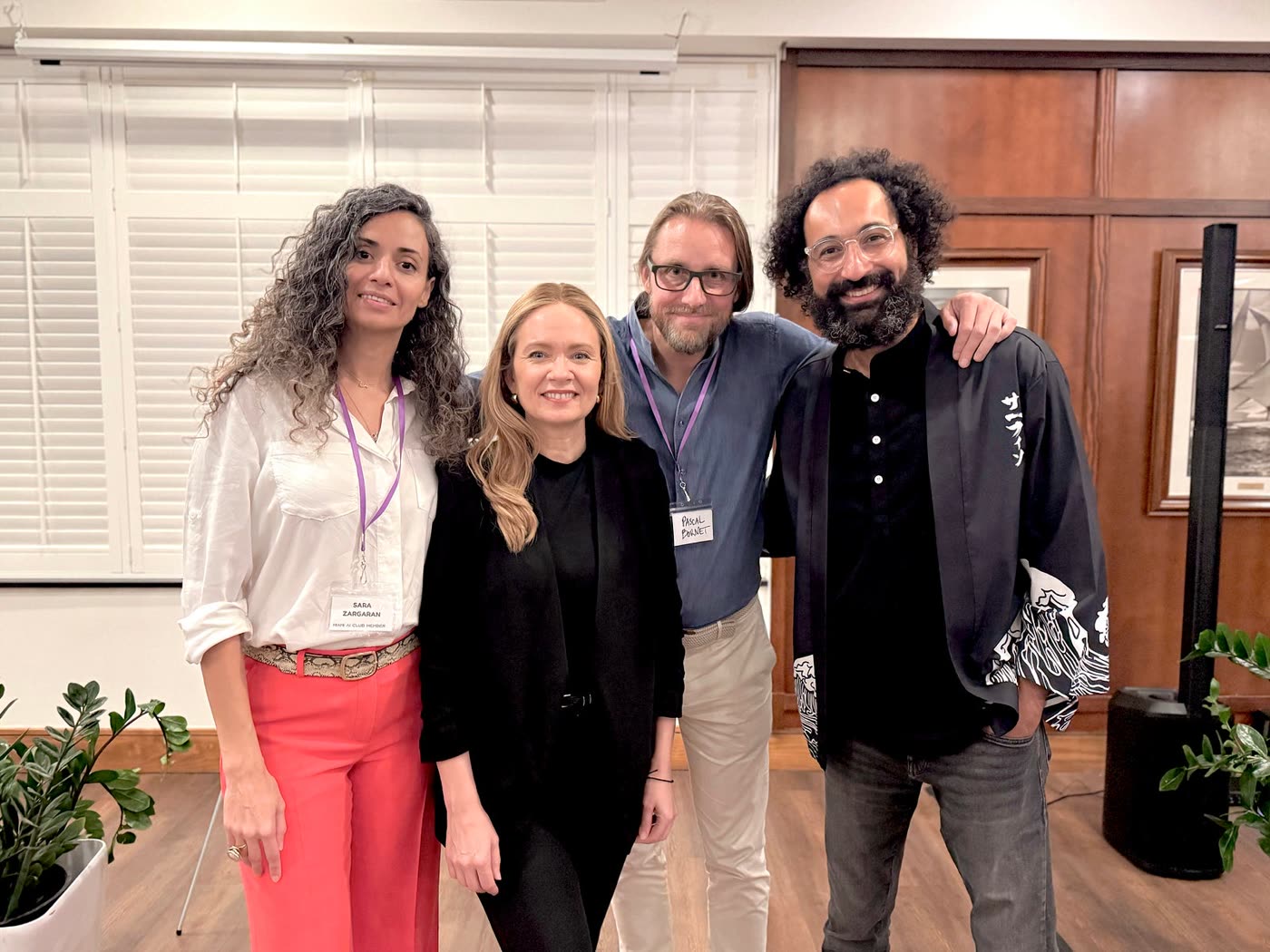
Founded by Nima Schei, MD, and Sara Zargaran, Miami AI Club is an exclusive network of influential leaders, innovators, and visionaries who share a passion for artificial intelligence and its potential to transform the world for the better. The AI Community examines the best practices and strategies to harness the power of AI in various domains while ensuring ethical and responsible use of this technology to avoid disastrous consequences.