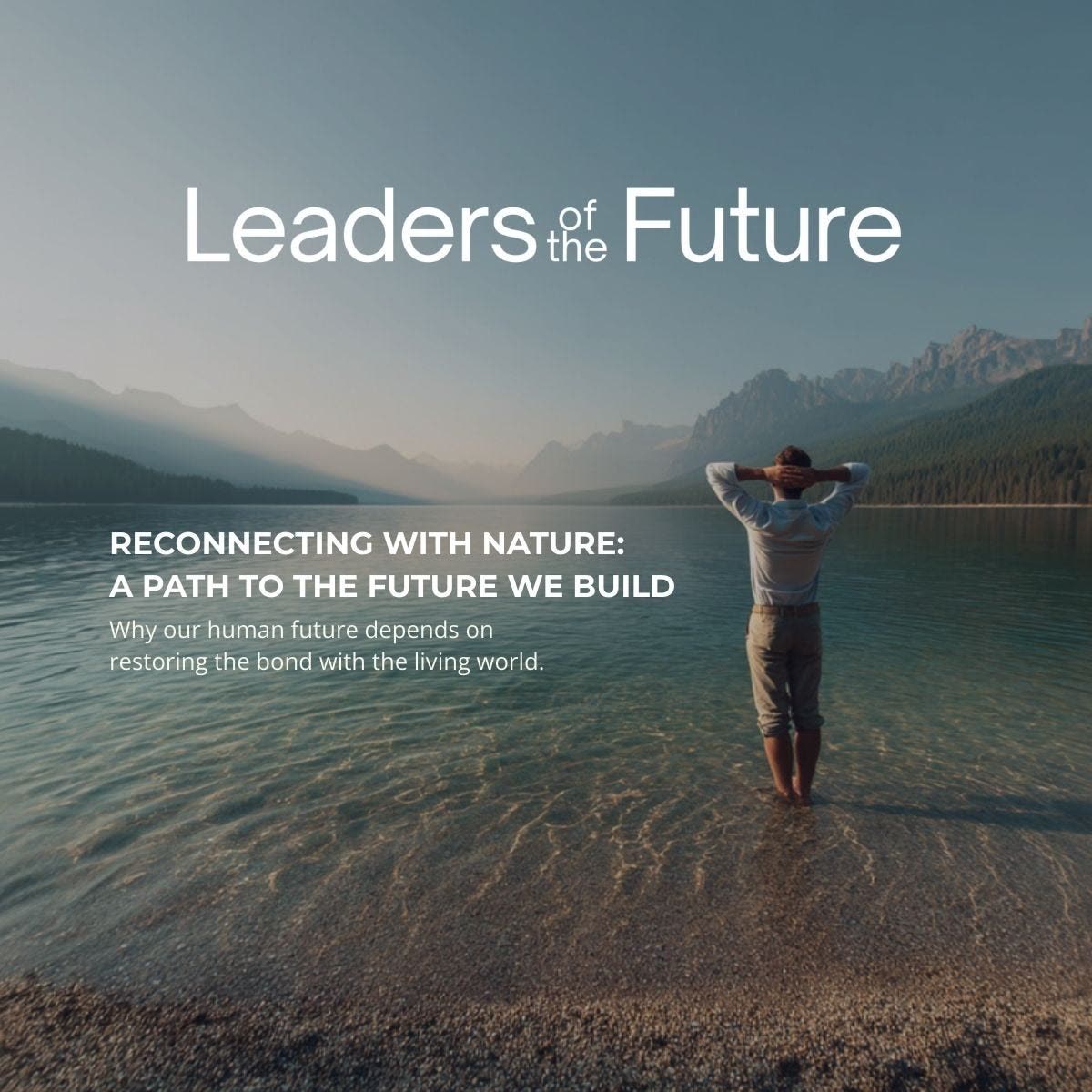
A landmark study led by Professor Miles Richardson at the University of Derby reveals something both alarming and clarifying: our human connection to nature has declined by more than 60% in the past 220 years. This decline is mirrored by the disappearance of words like river, blossom, and moss from our language. What disappears from daily life often disappears from imagination too.
Researchers warn this trend could lead to an “extinction of experience.” If people no longer encounter nature, they lose both the memory and the motivation to protect it. And if we fail to protect it, we lose one of the most vital foundations of our future.
The findings were published in Earth under the title “Modelling Nature Connectedness Within Environmental Systems: Human-Nature Relationships from 1800 to 2020 and Beyond” and reported widely, including by The Guardian here.
What the research tells us
- Everyday nature is vanishing. Encounters with trees, birds, and rivers are no longer part of daily life.
- Urbanization steals traditions. Children grow up surrounded by concrete, with fewer elders passing on stories of the natural world.
- We risk forgetting to care. The less we connect, the less we protect.
Yet this is not only a story of loss. The same research shows that recovery is possible, if we act boldly to embed nature in our cities, our families, and our leadership.
What leaders can do now
- Green our spaces. Champion rooftop gardens, natural classrooms, and living walls in urban life.
- Protect childhood wonder. Make nature part of education and family rituals, from shared stories to time outdoors.
- Lead by example. Create cultures that value walk-and-talk meetings, time outside, and retreats in nature as integral to performance and well-being.
Why this matters for the future of humanity
What matters most now is how we choose to live and lead as humans in the future.
If the last century pulled us away from nature, the next must restore that bond as a core human capacity, as essential as digital literacy or emotional intelligence. The leaders who thrive tomorrow will be those who know how to balance ambition with humility and and innovation with a living connection to the natural world.
My own perspective
For me, this research really hit home. Growing up in Finland, where over 70% of the land is forest, nature has always been a part of my everyday life. I have seen how a quiet walk in the woods or a moment by the lake can spark new ideas and reconnect me with my creativity. Even the simplest pause outdoors has helped me move through challenges and remember what really matters.