This month has been one of the most intense and revealing periods in my work with AI this year. Every week brought new model releases, new demonstrations of capability, and new conversations about what the coming year may hold. The speed of development has been both inspiring and sobering. It has made me pause and take a much closer look at the world we are now stepping into as we move toward 2026.
Throughout November, I found myself moving between excitement and concern. The excitement came from witnessing breakthroughs many in the AI ecosystem believed were still years away. The concern came from seeing how these advances will reshape our workforce, redefine the meaning of work, and impact people on an individual level. Layoffs across major corporations are increasing, and I’m not sure any of us yet grasp the scale of change that is approaching.
My November reflections come from conversations with leaders across industries, researchers who have tracked these trends for years, and teams beginning to feel the early effects of this new intelligence in their daily work.
I have gathered the three defining themes, the pulse points of November below.

I. Intelligence Explosion, A New Phase of AI Has Begun
Across the AI sector, November marked the beginning of what many in the field now describe as exponential intelligence. We have moved beyond the steady, predictable progress we were accustomed to and entered a new phase in which systems improve by building on their own capabilities and by collaborating in ways that were not possible even a year ago.
The release of Gemini 3.0, Claude’s growing agentic ecosystem, and early digital counterparts signal a real structural shift in AI. These systems now sustain context-rich conversations, coordinate multi-step actions across tools, and are beginning to anticipate goals instead of just waiting for instructions.
I see this as our first real glimpse of an agent-to-agent economy, a world in which intelligent agents representing individuals, teams, or entire companies will collaborate, negotiate, and execute tasks independently.
One of the most significant advances in this shift is the rise of the digital counterparts at work. These “Digital Twins as employees” learn how a person works, remember their preferences, track commitments, and gradually become part of their cognitive toolkit. Their emergence will fundamentally reshape how organizations capture and operationalize knowledge, much of which is created and updated daily inside the minds of their employees.
Yet this field is still forming, and so are the questions it raises.
- How do we define these digital counterparts?
- What do they mean for individual employees and the professional intelligence they have built over their careers?
- Who owns this knowledge once it becomes embedded in corporate AI systems?
- And what safeguards must be established to build trust and mitigate risk?
These breakthroughs offer tremendous promise, but they also demand new awareness. The speed at which these systems are evolving will test our ability to govern them responsibly.
The next 1,000 days will look nothing like the last 1,000.
We are entering a new intelligence environment that will accelerate and move faster than human comprehension, and challenge the structures that organizations rely on.

II. The Human Shift: Understanding the Impact on People
Behind all the exciting breakthroughs, many of us, myself included, are beginning to question our own role in this transformation: our identity, confidence, dignity, and our place in the future of work.
Over the past month, I’ve spoken with professionals across sectors, from senior executives to early-career talent. While many are fascinated by the pace of progress, I’ve also sensed a growing undercurrent of uncertainty. This became my most personal realization in November:
We are underestimating how deeply autonomous intelligence will affect the human experience of work.
In almost every conversation, similar questions surfaced, not from fear, but from honest reflection:
- What happens to my expertise when a system can complete my work in seconds?
- How do I trust decisions involving an agent I cannot fully understand?
- What is my value when the speed around me increases beyond what I can absorb?
These questions reveal something important: People are trying to find their footing in an environment that is accelerating faster than human cognition naturally adapts.
This concern has shaped my own thinking. The more I listen, the more I see the widening gap between technological capability and human readiness. As exciting as this moment is, many workers feel unprepared for the changes ahead. Many worry about job stability. Others worry about losing relevance as their knowledge is extracted into corporate training systems. Many wonder whether they will be supported as roles evolve.
The truth is that 2026 will likely bring workforce displacement on a scale we have not experienced, not because people are incapable, but because the structure of work is changing faster than our systems can support.
This is why leaders must shift the conversation.
It is not only about how we use AI to increase productivity.
The deeper, more urgent question is:
How do we protect human agency at a time when intelligence is accelerating beyond human pace?

III. The Leadership Shift: Responsibility for the World We Are Creating
The leader’s priority, as much as it is to adopt new technology, is to bring care and responsibility to every deployment decision. This must become the foundation of everything we do. We may be able to do extraordinary things with these intelligent systems, but we must always ask, should we? Productivity cannot come at the cost of human capacity or agency. Every decision we make, and every roadmap we build, must be guided by this principle.
These choices will also create profound ripple effects across communities and their economic stability.
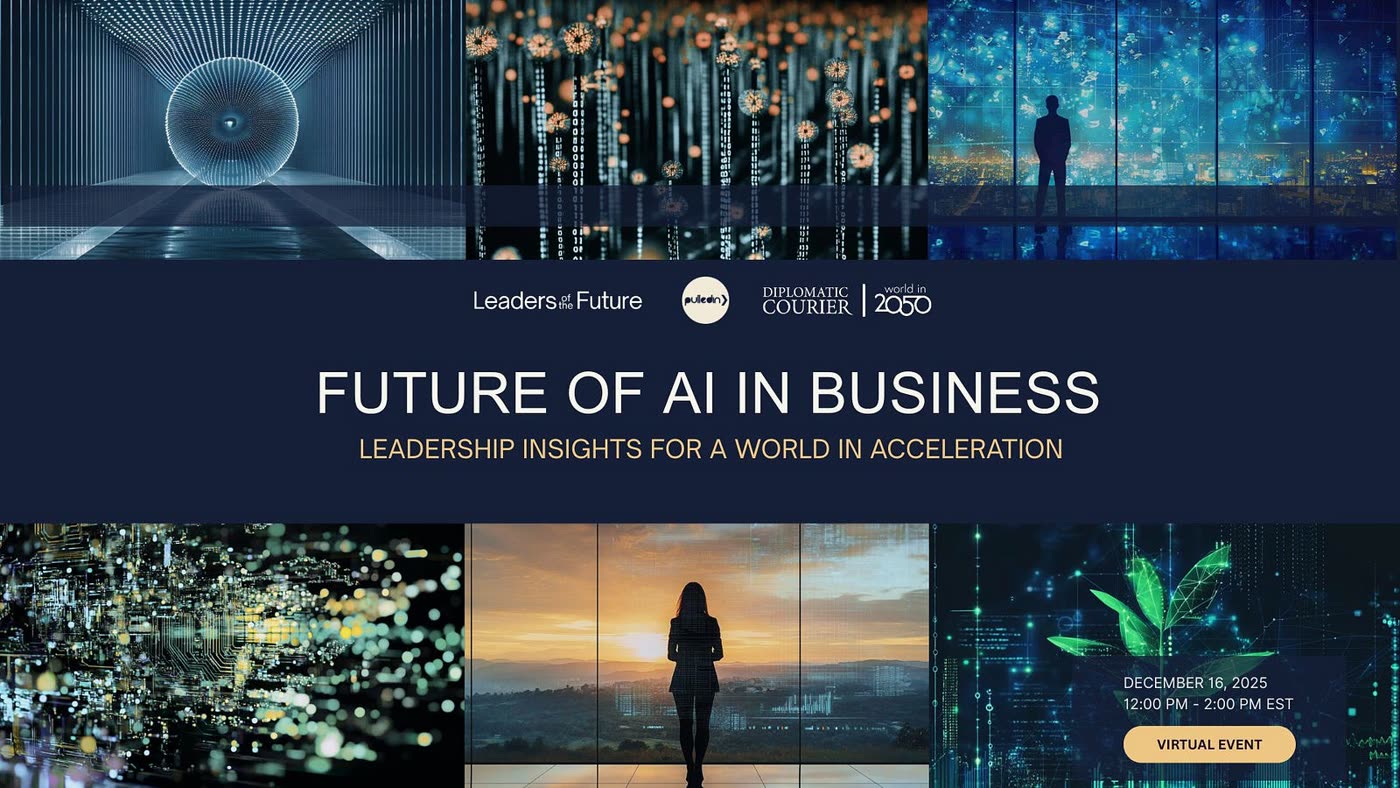
Join our December 16th Virtual Seminar to meet eight visionary leaders and connect with a global community as we share insights on how to prepare for 2026 as a leader.
I feel the weight of future of leadership shifting from an internal function to a civic responsibility. We are no longer guiding only our teams. We are helping shape the environment in which human beings and autonomous intelligence will coexist. This requires a clear sense of purpose and the willingness to make choices that honor long-term wellbeing over short-term efficiency.
One insight from November became impossible to ignore: no leader, no company, and no government can navigate this transformation alone.
The systems are developing too quickly, and the consequences are too interconnected. Collaboration is not a strategic choice, what I see it needs to become a safeguard and leadership priority.
This is why I am increasingly focused on advancing Leaders of the Future’s mission: to create a central place for leaders to share early signals, reflect on risks, compare insights and case studies, and learn from one another’s experience. We are already seeing leaders gravitate toward this kind of collaboration, guided by the belief that our individual intelligence becomes stronger when supported by collective intelligence, not through isolated decisions made behind closed doors.
Thank You, November
This has been a month of acceleration on a personal level. I have spent November moving between keynote stages, panel discussions, advisory meetings, and long conversations with leaders across industries. It has been a month of travel and learning and I feel very fortunate to have been part of so many thoughtful dialogues at a moment when the world is changing so quickly.
I am inspired by what is becoming possible. I am also increasingly aware that most of us do not yet grasp how fast this shift is unfolding, or how deeply it will reshape the meaning of work, our professional identity, and the way we must reinvent leadership itself.
As we move into December and begin closing out the year, I feel energized by the work ahead. In early 2026, you will see me focus even more deeply on the individual professional, supporting people through this transition, helping them capture and preserve their knowledge and agency, and preparing them to adapt to the shifts in roles and job structures that lie ahead.
With Gratitude, Tarja